
 (888) 884-2161
 Why Every Immigration Attorney Needs a Virtual Paralegal in 2026?
  Book a demo to build your team today
It was a crisp Albuquerque morning, and the law office buzzed with urgency. Phones rang, attorneys hustled between desks, and stacks of client files towered over the conference-table.
Senior immigration attorney John Doe and his colleague Jan Doe paced through one of their most complex employer-based petitions the financials of the sponsoring company looked shaky, the ability-to-pay argument was tenuous, and the looming filing deadline was non-negotiable.
A Conversation Between Two Top Attorneys: John and Jan
John:
“Jan, this EB-2 case we’re reviewing for the New Mexico employer is messy. Their tax returns don’t neatly support the wage offer, and if we don’t present a rock-solid ability-to-pay file, USCIS may hit us with an RFE which could derail the timeline.”
Jan:
“I hear you, John. That’s exactly why I’ve started working with remote immigration paralegal specialists. They gather the tax records, compile the payroll summaries, map out the narrative for ability-to-pay, and present it in a format that USCIS handles easily. It means we spend less time on logistics and more time on strategy.”
John:
“Remote paralegals? I always assumed paralegal work had to be on-site to keep control. How do they manage the details, especially for immigration work where precision and context matter?”
Jan:
“They’re not just admin staff. These are virtual immigration paralegal services trained for immigration law. For this New Mexico employer case, they pre-sorted documents, checked for inconsistencies, flagged potential weak spots in the ability-to-pay narrative, and organised the entire submission package. It saved me hours — maybe even days.”
John:
“Okay… I’m intrigued. Show me how this has worked for you in practice maybe I should consider integrating one into my workflow too.”
Why Immigration Attorneys in New Mexico Are Turning to Virtual Paralegal Services ?
That conversation between John and Jan highlights a pivotal shift in immigration law practice, especially for attorneys in states like New Mexico. With caseloads rising, regulatory complexity increasing, and competition growing, many immigration attorneys are discovering that partnering with virtual immigration paralegals isn’t just a convenience — it’s becoming a strategic necessity.
In this article, we’ll explore why every immigration attorney in New Mexico should seriously consider virtual immigration paralegal services, how those services address the major pain points in immigration practice, and how you can implement them effectively in your firm.
The Role of Virtual Immigration Paralegal Services for Immigration Attorneys in New Mexico
What Is a Virtual Immigration Paralegal Service?
A virtual immigration paralegal service refers to a remote legal‐support entity specialising in immigration law workflows. Unlike general virtual assistants, these paralegals:
-
are trained in immigration case preparation (e.g., employer-based filings, family-based petitions, adjustment of status).
-
assist attorneys by handling documentation, forms (such as I-140, I-485, I-129, DS-260), evidence organisation, deadlines, and case intake support.
-
operate remotely, allowing attorneys in states like New Mexico to access top-tier support without hiring locally.
This means for your New Mexico-based immigration law practice, you can leverage specialised support while focusing on legal strategy, client interaction, and growth.
Why Immigration Attorneys in New Mexico Benefit from These Services
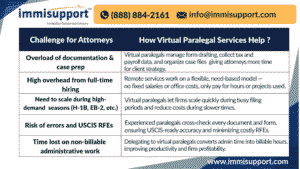
Practical Steps: Implementing Virtual Paralegal Services in Your Practice
Here’s how to integrate virtual immigration paralegal support effectively into your New Mexico immigration law firm:
-
Define Your Needs
Determine which tasks create bottlenecks (e.g., ability-to-pay analyses, form drafting, document collection). -
Select a Specialist Provider
Choose a service that has immigration‐law experience (not just generic paralegal) and understands employment‐based filings, ability-to-pay requirements, and USCIS expectations. -
Set Clear Workflows & Standards
Outline responsibilities, deadlines, document review procedures. Use secure platforms for file sharing and communications—remote work demands it. -
Integrate with Your Case Management System
Link the virtual paralegal’s work into your case system (whether cloud-based or local). Ensure roles are clear: attorney controls strategy, paralegal handles prep. -
Measure and Improve
Track metrics like turnaround time, number of RFEs, attorney billable hours saved, and client satisfaction. Adjust workflows to optimise.
Cost & Value: Why It Makes Financial Sense
-
Virtual paralegal arrangements often cost significantly less than hiring a full-time in-house paralegal (no office space, benefits, equipment).
-
By freeing attorneys’ time from administrative tasks, more billable hours become available, enhancing revenue potential.
-
For a New Mexico attorney, the efficiency gains mean you can take on more employer‐based petitions, more client consultations, and scale your practice without proportional staff growth.
What Did We Learn
-
Virtual immigration paralegal services are highly relevant for immigration attorneys in New Mexico facing heavy documentation and case management burdens.
-
These services offer cost-savings, scalability, and access to immigration‐specific expertise.
-
To succeed with them, attorneys must define workflows, choose the right provider, and integrate remote support into their systems.
-
The result: fewer bottlenecks, more billable time, and stronger client outcomes.
What People Are Asking?
1.What tasks can a virtual immigration paralegal handle for my New Mexico practice?
They can manage document collection, draft immigrations forms (e.g., I-140, I-485), prepare ability-to-pay analyses, coordinate client intake, track deadlines and ensure consistency across filings.
2.How do I maintain control over cases when using remote paralegal support?
Establish clear workflows, designate document review stages for the attorney, and use secure, cloud‐based file sharing so you oversee strategy while the paralegal handles preparation.
3.Is hiring a remote paralegal legal and compliant for immigration work in New Mexico?
Yes as long as you are a licensed attorney, you oversee and supervise the work. Virtual paralegals assist; they do not provide legal advice. Ensure data protection protocols are in place.
4.How quickly can I scale up during a busy season (e.g., employer filings) using virtual paralegals?
Very quickly remote services allow you to engage additional resources on short notice without the delays of hiring full‐time staff.
5.How do I measure the impact of virtual paralegal support on my firm’s performance?
Track time saved per case, number of RFEs issued (and reduced), attorney billable hours, case turnaround time, and client satisfaction. Use those metrics to assess ROI and refine workflows.
Disclaimer:
For informational purposes only; not applicable to specific situations.
For tailored support and professional services,
please contact Immisupport, at +1 888 884 2161
Email: info@immisupport.com
Book a Demo: https://immisupport.com/demo/
Rated 4.9/5 by immigration attorneys. If you are looking for Outsourcing services for your Immigration practice, please email 📧info@immisupport.com or call 📞(888) 884-2161.
 By James Paul

Was this helpful?
 (No Ratings Yet)
 Loading...
  Read Case Studies
Ready to build your team
 Read Success Stories
Services


Recent Posts
Informative Videos


 (No Ratings Yet)Loading...


 let’s talk - meet with Immigration Outsourcing expert