
 (888) 884-2161
 Top Tasks a Virtual Legal Assistant Can Handle for Immigration Attorneys
  Book a demo to build your team today
It was early on a brisk Thursday morning in Atlanta, and the lawyers’ lounge was alive with the low hum of discussion, printers working overtime, and fresh mugs of coffee being poured. John and Jan two seasoned immigration attorneys—were seated across from each other with a new employment-based case file open in front of them.
They had just received an EB-2 petition from an employer in Georgia. The employer’s financial statements looked solid on the surface, but John already sensed trouble beneath: inconsistent payroll reports, spotty revenue growth, and a likely “ability to pay” issue looming.
A Conversation Between Two Top Attorneys: John and Jan
John: “Jan, this EB-2 petition from the Georgia employer is looking like a minefield. Their tax returns jump around, payroll doesn’t align year-to-year USCIS is going to zero in on ability to pay. If we don’t get ahead of this, we’ll be prepping for an RFE instead of an approval.”
Jan: “I totally hear you. But remember, we’ve streamlined our process since bringing in a virtual legal assistant for immigration attorneys in Georgia. They’re going through the financials, organizing documents, and drafting the summary we’ll use. That frees us to focus on the legal strategy.”
John: “Virtual legal assistant? I’ve used in-house paralegals for decades. But can an off-site assistant really dive deep into the ability-to-pay nuance—wage requirement, revenue stability, cash flow with the rigor USCIS expects?”
Jan: “Absolutely. These virtual paralegals specialise in immigration law workflows. They pull three years of returns, reconcile payroll and W-2s, tip us off to red flags, and draft clear explanations for us. In our last Georgia-based case, we avoided an RFE because the assistant flagged a mismatch before we even filed.”
John: “That’s impressive. So they’re doing more than data entry they’re practically part of the team?”
Jan: “Exactly. And for a busy immigration attorney in Georgia, having that support means fewer late nights, fewer missed details, and stronger petitions filed in less time.”
From Daily Challenges to Digital Solutions: Why Georgia Attorneys Rely on Virtual Legal Assistants
As John and Jan’s conversation reveals, the biggest bottleneck in many employment-based immigration filings especially in Georgia is not legal theory but process and documentation. When an employer’s finances don’t cleanly demonstrate the ability to pay the wage, or forms are inconsistent, the risk of RFEs and delays climbs steeply.
That’s where hiring a virtual legal assistant for immigration attorneys in Georgia becomes a game-changer. By off-loading the detailed, time-consuming work to a trained professional familiar with immigration workflows, attorneys reclaim focus for legal strategy, client communication, and case outcomes.
How Virtual Legal Assistants Simplify Immigration Workflows ?
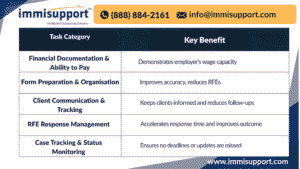
1. Detailed Financial Documentation & Ability to Pay
In employment-based petitions, especially EB-2 or EB-1, one of the most scrutinised areas is whether the employer can actually pay the offered wage from the date of filing onward. For immigration attorneys in Georgia, this means reviewing state tax returns, federal tax returns, payroll records, W-2s, and more.
A virtual legal assistant can:
-
Collect and organise three years of federal and Georgia state tax returns
-
Reconcile W-2s and payroll figures with the tax documents
-
Identify red flags (e.g., sudden dip in net income, missing payroll)
-
Draft an “Ability to Pay Summary” for attorney review, aligning with USCIS standards
Example: The virtual assistant identifies that although the employer’s net income dropped in year two, cash flow and retained earnings remained strong. This allowed John and Jan to build a narrative around business continuity and ability to pay rather than heading into filing blind.
2. Form Preparation & Document Organisation
Filing petitions with the United States Citizenship and Immigration Services (USCIS) demands precise and consistent documentation. Fields must match across the I-140/I-485 (or other relevant forms), covering employer’s address, business name, payroll, and offered wage. One mismatch can trigger a Request for Evidence (RFE).
A virtual legal assistant handles:
-
Data input cross-checking across forms and supporting evidence
-
Organising exhibits (labelled, bookmarked, consistent) ready for filing
-
Tracking internal deadlines (e.g., filing, premium processing, biometrics)
Result: Attorneys avoid unnecessary RFEs, streamline review time, and maintain higher submission quality.
3. Client Communication & Follow-Up Workflow
Clients often expect constant updates even when there’s nothing new. For busy immigration attorneys in Georgia managing multiple cases, this becomes a time drain.
Virtual legal assistants can:
-
Send templated yet personalised status updates to clients
-
Follow up for missing documents (via secure portals)
-
Schedule meetings, track outstanding items, and escalate when needed
Benefit: Attorneys regain time and clients feel well-informed and supported.
4. RFE Pack Preparation & Strategy Support
When an RFE hits, timing and presentation matter greatly. A virtual legal assistant can:
-
Pull all requested documents and organise them into index-tabs
-
Draft and format the response outline for attorney approval
-
Create a checklist to ensure nothing is missing before submission
Example: In a recent Georgia-based E-2 employer case, when USCIS requested proof of five years of revenue, the assistant compiled three years of audited statements, two years of management accounts, and a sworn affidavit of business continuity. The attorney’s final review was delivered in half the usual time.
5. Case-Tracking & Monitoring
Staying on top of case status updates—from receipts, biometrics, approval notices—is key for immigration practice management.
Virtual legal assistants can:
-
Monitor USCIS portals for status changes
-
Update internal case management software (CMS) or CRMs
-
Generate weekly reports for attorneys, flagging upcoming deadlines or client alerts
Impact: Proactive management reduces surprises and ensures client expectations are managed effectively.
What Did We Learn ?
-
A virtual legal assistant for immigration attorneys in Georgia can handle critical tasks like financial documentation, form preparation, client follow-up, RFE response, and case tracking.
-
These assistants allow attorneys to off-load detailed tasks and focus on legal strategy, enhancing productivity and case outcomes.
-
For attorneys in Georgia managing employment-based immigration cases, the right support means fewer delays, improved accuracy, and higher client satisfaction.
What People Are Asking?
1. What are the basic steps for H-1B visa sponsorship for employers?
The main steps include: determining job eligibility, filing a Labor Condition Application (LCA) with the Department of Labor, submitting Form I-129 to USCIS, entering the H-1B lottery (if applicable), and completing onboarding once approved. Each step must comply with DOL and USCIS guidelines to avoid delays.
2. How long does the H-1B sponsorship process take for employers?
Typically, the H-1B visa process can take 3 to 6 months, depending on USCIS processing times and whether premium processing is used. Premium processing can reduce the waiting period to around 15 calendar days.
3.What are the eligibility requirements for an H-1B position?
The job must be a specialty occupation requiring a bachelor’s degree or higher in a specific field related to the role.
4. Can small or startup businesses in the U.S. sponsor H-1B visas?
Yes, small businesses and startups can sponsor H-1B workers if they can demonstrate ability to pay the offered wage and that the position qualifies as a specialty occupation. They must also show proof of ongoing business operations.
5. What happens if an H-1B petition is denied or not selected in the lottery?
If not selected, the employer can reapply in the next fiscal year. If denied, the employer may file a motion to reopen, appeal, or refile after addressing the issues cited by USCIS.
Disclaimer:
For informational purposes only; not applicable to specific situations.
For tailored support and professional services,
please contact Immisupport, at +1 888 884 2161
Email: info@immisupport.com
Book a Demo: https://immisupport.com/demo/
Rated 4.9/5 by immigration attorneys. If you are looking for Outsourcing services for your Immigration practice, please email 📧info@immisupport.com or call 📞(888) 884-2161.
 By James Paul

Was this helpful?
 (No Ratings Yet)
 Loading...
  Read Case Studies
Ready to build your team
 Read Success Stories
Services


Recent Posts
Informative Videos


 (No Ratings Yet)Loading...


 let’s talk - meet with Immigration Outsourcing expert